Three CEAP modes
Choose the level of detail that fits the clinical task.
Basic CEAP creates a concise record, Advanced CEAP adds all selected clinical classes and venous segments, and Advanced+ opens the diagnosis and scoring modules.
iOS tool for vascular surgery
Choose Basic CEAP, Advanced CEAP, or Advanced+, document the right and left limbs independently, build a clinical diagnosis, assess severity with rVCSS, VSDS, and VDS, and share the result from iOS.
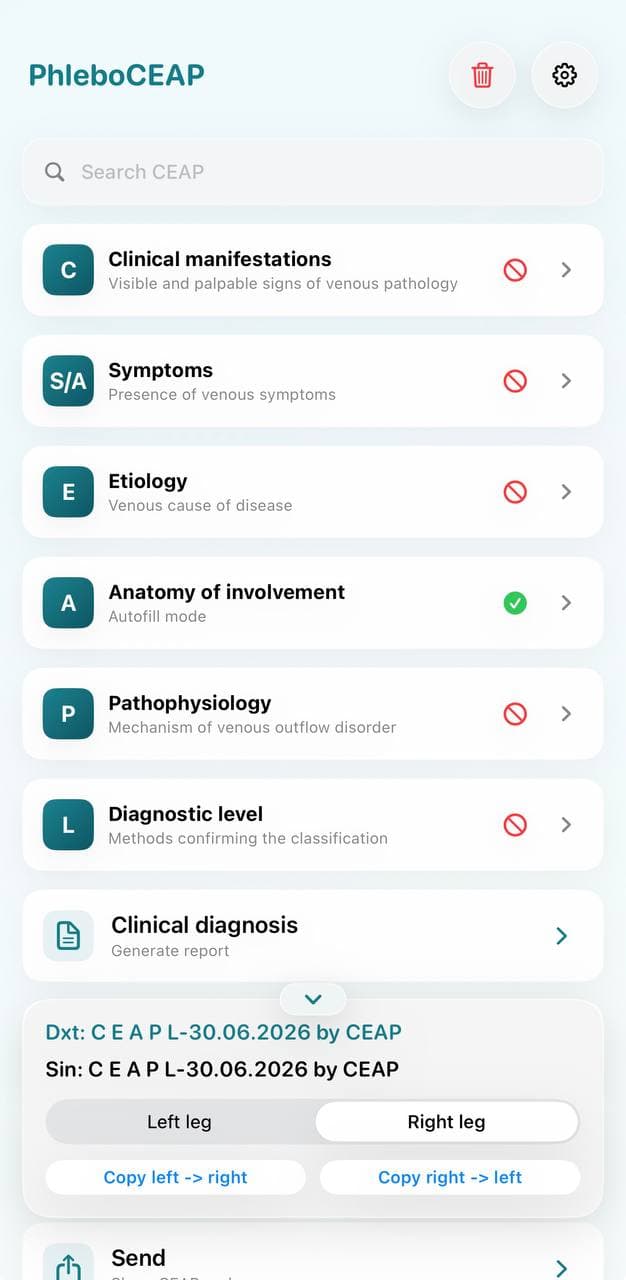
3 modes
Basic / Advanced / Advanced+
Dxt / Sin
separate coding for each leg
rVCSS / VSDS / VDS
severity and disability scales
Three CEAP modes
Basic CEAP creates a concise record, Advanced CEAP adds all selected clinical classes and venous segments, and Advanced+ opens the diagnosis and scoring modules.
Daily workflow
If the pathology is the same in both legs, code one limb and copy the coding to the other.
Clinical diagnosis
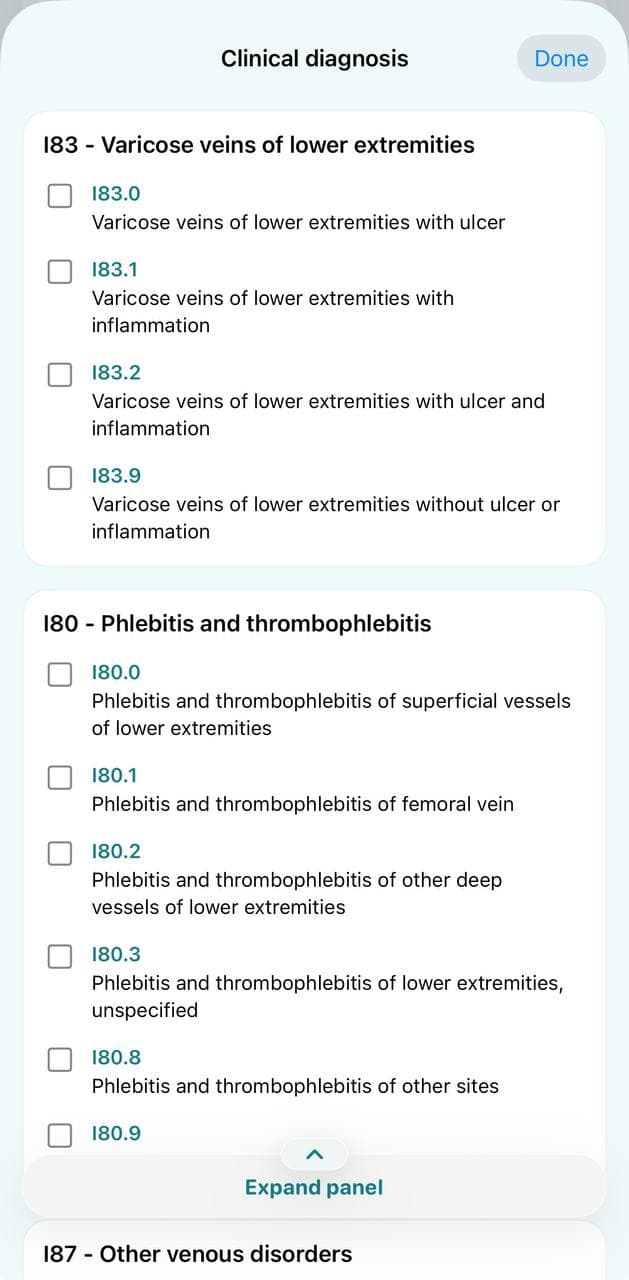
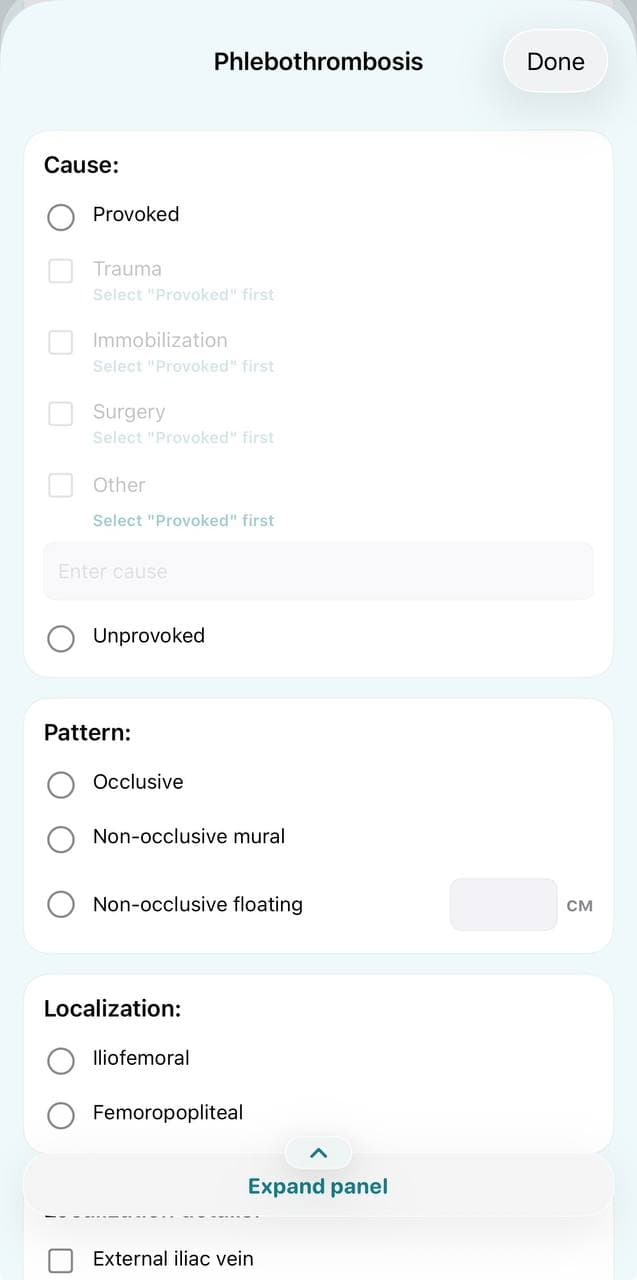
Build diagnosis text with NK 025:2021 / ICD-10-AM codes, the Saveliev CVI classification, varicose disease, thrombophlebitis, and phlebothrombosis options.
rVCSS · VSDS · VDS
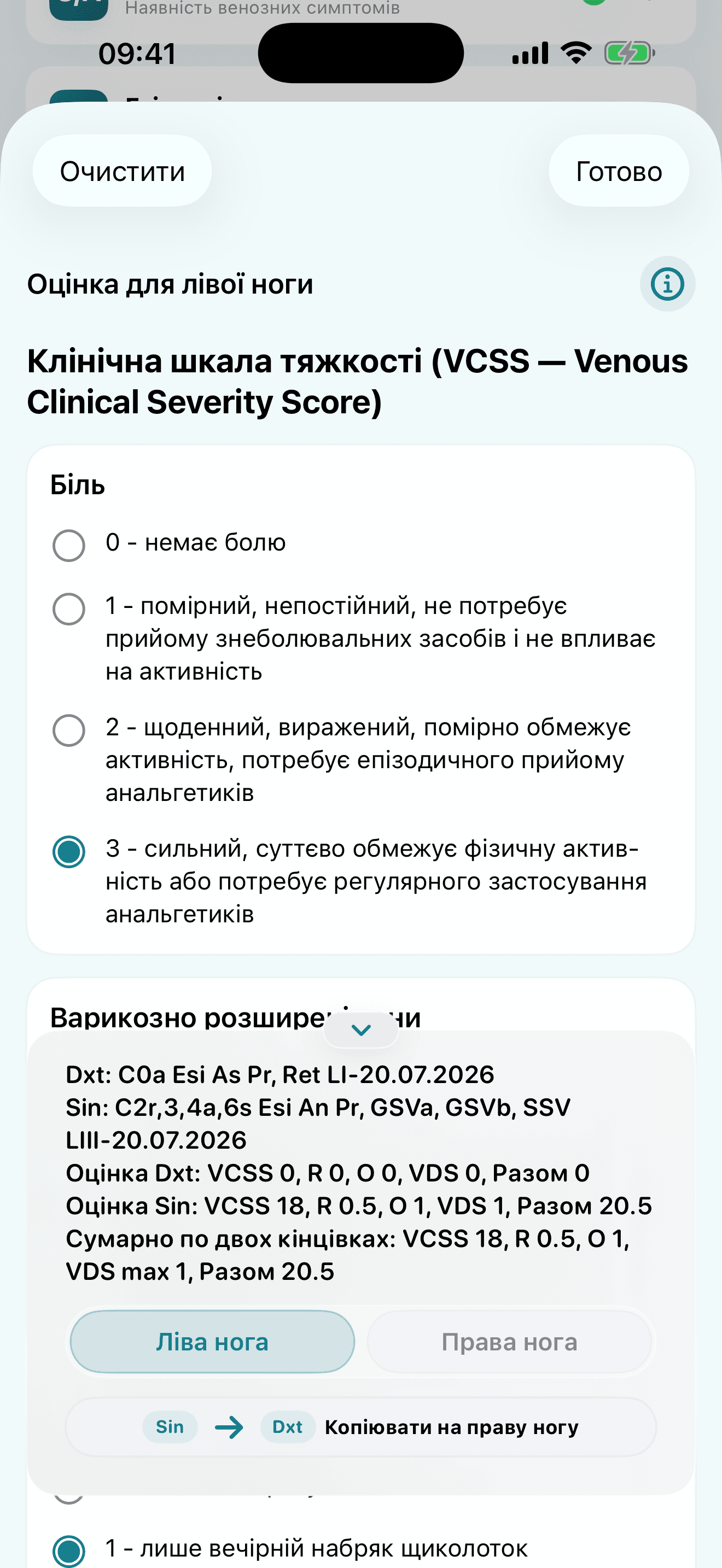
Complete revised VCSS, segmental reflux and obstruction scores, and the patient VDS. Right and left limb results remain separate and can also be presented together.
C E A P L
Three operating modes: Basic CEAP, Advanced CEAP, and Advanced+.
CEAP-2020 code generation across C, E, A, P, and L sections.
Clinical classes C0-C6, including recurrent disease and C4a, C4b, C4c subtypes.
Etiology options En, Ep, Es, Esi, Ese, and Ec.
Pathophysiology with reflux, obstruction, combined patterns, and venous segment details.
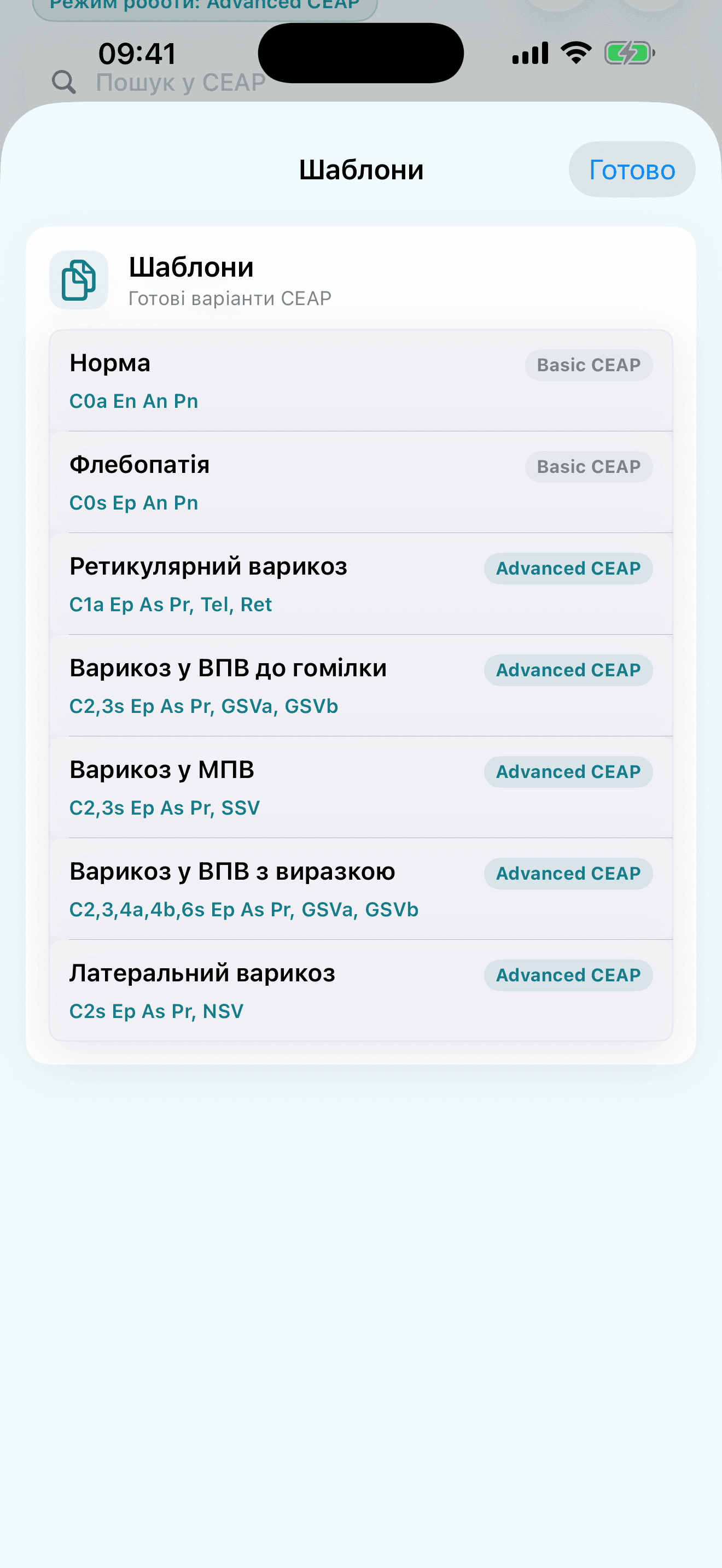
Built-in templates plus custom templates saved directly from the current result.
Search by CEAP code or segment name, including C6, GSV, reflux, and related terms.
CEAP transcript mode for reviewing the selected classes, terms, and segments.
rVCSS, VSDS, and VDS assessment with separate right and left limb results.
Copy or share CEAP alone or the full result with the clinical report; reorder the action buttons with a long press and keep that order after relaunch.
Ukrainian and English interface with light and dark modes.
VoiceOver, Dynamic Type, larger system text sizes, and landscape orientation support.
Built-in help and confirmations before clearing data or applying templates.
Version 1.1.0
The current App Store version expands both CEAP coding and the supporting clinical workflow.
Switch between Basic CEAP, Advanced CEAP, and Advanced+ without losing the purpose of each format.
Save a custom template from the current result and use updated built-in templates marked by CEAP mode.
Open the CEAP transcript to review selected items and temporarily exclude or restore individual entries.
Assess rVCSS and VSDS separately for Dxt and Sin, add the patient VDS, and keep unilateral and bilateral output clear.
Build a clinical diagnosis using NK 025:2021 / ICD-10-AM and the Saveliev classification.
Long-press and drag diagnosis-panel actions into the preferred order; the order is restored after the app is reopened.
Use improved VoiceOver, Dynamic Type, large-text, and landscape support.
I83 / I80 / I87
CEAP-2020 is a structured classification for chronic venous disease and varicose veins. PhleboCEAP turns clinical class, etiology, anatomy, pathophysiology, and diagnostic level into a clear code for documentation.
CEAP-2020 clinical classification guideThis phlebology app is designed for daily venous practice: separate right and left leg coding, fast templates, segment-level reflux or obstruction details, and a result that is ready to share from iPhone or iPad.
Tool for vascular surgeonsLearn how CEAP classification is implemented in a medical iOS app with bilateral limb support, automatic code assembly, and clinical export ready for bedside documentation.
CEAP iOS implementationBeyond CEAP coding, PhleboCEAP helps prepare a clinical diagnosis for varicose veins and related venous disease with ICD-10 groups I83, I80, and I87.
ICD-10 support in clinical diagnosis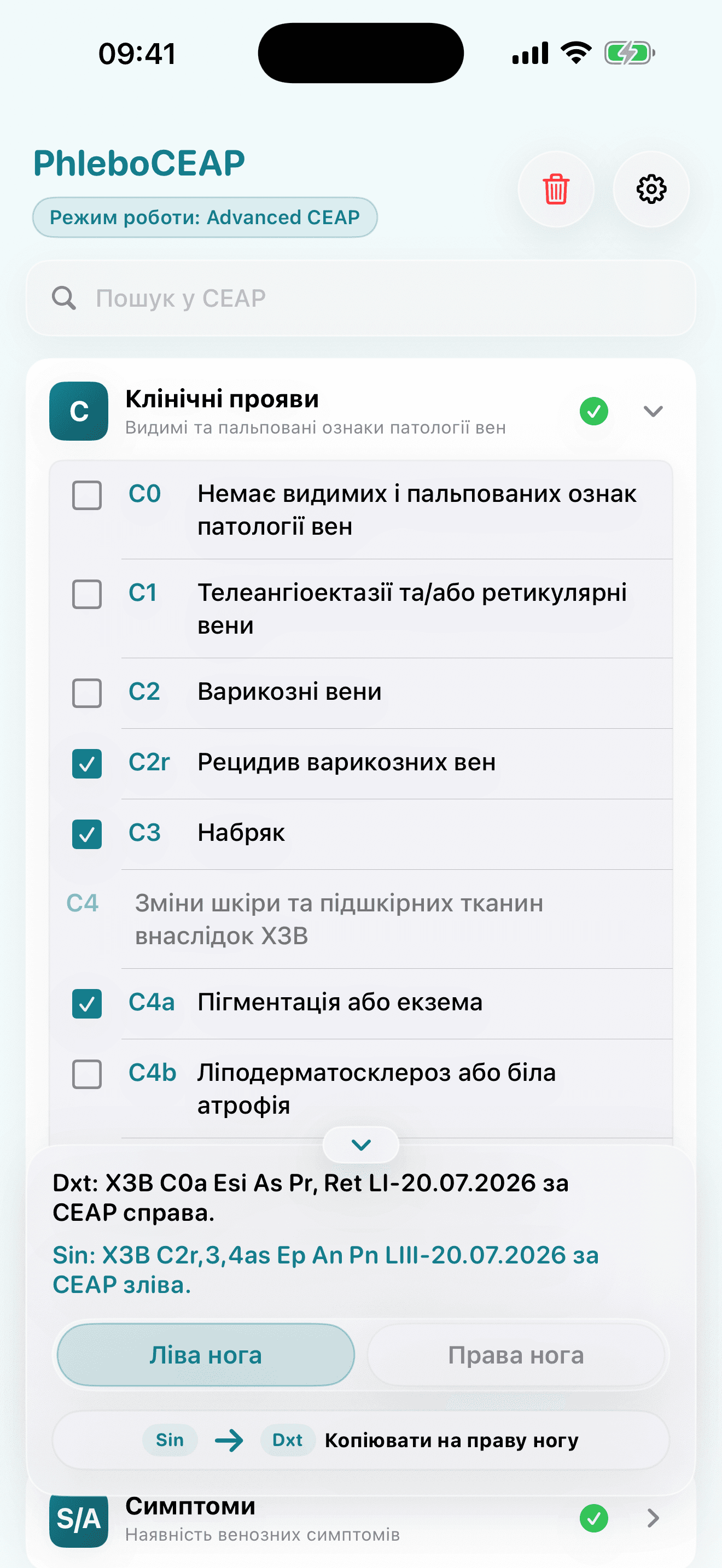
CEAP-2020 is a structured classification for chronic venous disease. It describes clinical class, etiology, anatomy, pathophysiology, and diagnostic level in a consistent code.
No. PhleboCEAP is a documentation aid for clinicians. The physician remains responsible for the clinical assessment, final diagnosis, and treatment decisions.
The clinical diagnosis module supports ICD-10 groups I83, I80, and I87 for venous disease scenarios such as varicose veins, phlebitis, thrombophlebitis, and related venous disorders.
Yes. PhleboCEAP supports separate Dxt and Sin coding, with copying between legs when the clinical pattern is similar.
Basic CEAP produces a concise record with one highest clinical class. Advanced CEAP adds all selected clinical classes, venous segment detail, and diagnostic level. Advanced+ also enables the clinical diagnosis and rVCSS, VSDS, and VDS modules.
Yes. You can save custom templates from the current result. You can also long-press and drag the diagnosis-panel actions; their order is preserved after relaunching the app.
PhleboCEAP is distributed through the App Store as a mobile application. On Apple Silicon Macs with iOS app compatibility enabled in the App Store, it may be installable as an iOS app.
Use Basic, Advanced, or Advanced+ CEAP-2020 coding, NK 025:2021 / ICD-10-AM diagnosis workflows, the Saveliev classification, and rVCSS, VSDS, and VDS scoring—all practical tools in one app.

PhleboCEAP is a documentation aid for clinicians. It helps prepare CEAP codes and diagnosis wording, but it does not replace clinical judgment or the physician's responsibility for the final diagnosis.
Who built PhleboCEAP

Kyrylo Yarovyi
Co-founder & Technical Lead
Responsible for the architecture, software development, and technical implementation of PhleboCEAP.

Ihor Maiboroda
Co-founder & Product and Clinical Lead
Senior surgeon. Responsible for the product concept, clinical logic, functional requirements, testing, and development strategy.